
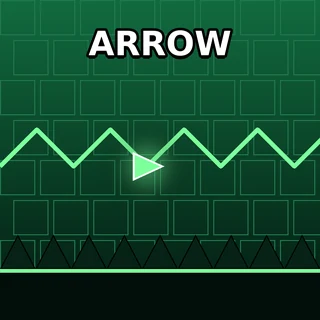







Play the Geometry Dash wave as an endless run: hold to climb 45 degrees, release to dive, and keep the zigzag inside a corridor that keeps narrowing. Free, no download.
The wave, on its own
The wave is the form that splits Geometry Dash players in half. Everything else in the game is timing — you press at the right moment and the cube does the rest. The wave is not timing, it is steering. Hold and you travel up at exactly 45 degrees; let go and you travel down at exactly 45 degrees. There is no acceleration, no momentum and no forgiveness: the line you draw is the line you get.
That is why people practise it separately, and it is why this page exists. The game above is a wave corridor and nothing else — no cube section to get through first, no level to restart from the beginning. It starts wide, it narrows the further you fly, and it is over the moment you clip an edge. Your best distance is saved in the browser.
How to control the wave
- Short inputs, not long ones. A one-second hold in a two-block corridor is already a crash. Most wave sections are flown with taps measured in tenths of a second.
- Aim at the gap, not at the wall. Beginners steer away from whatever is about to hit them, which puts them into the opposite wall half a second later. Pick the point you want to be at and fly a straight line to it.
- Straight corridors want a flat zigzag. Even, alternating taps hold a near-horizontal line. The smaller the zigzag, the more room you have for a mistake.
- Diagonal corridors want no input at all. A corridor sloping down at 45 degrees is flown by releasing and doing nothing. Fighting it is what kills you.
Mini-wave, dual wave and the rest
In the full game the wave has variants. The mini wave is half size, which sounds easier and is not: it is faster to react with but the corridors built for it are tighter still. The dual wave gives you two waves mirrored around the centre line and a single input that controls both, which is the single most-failed mechanic in extreme demons. Speed portals change everything again — at 2x and 3x the angle is the same but you have half or a third of the time to commit to it.
The corridor above runs at a constant speed and gets tighter with distance, which trains the one habit that transfers to all of those: making small corrections early instead of big ones late.
Wave spam
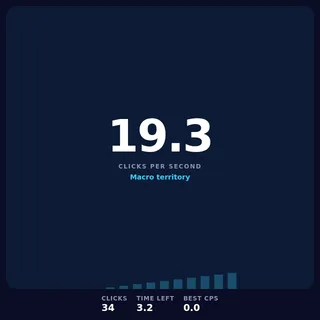
Some sections are not flown, they are spammed — a near-vertical climb that only holds if you can alternate at ten-plus clicks a second. That is a different skill with a different ceiling, and you can measure yours on the Geometry Dash spam test. If your clean wave control is good and you still die in the same place, spam rate is usually the reason.
Where the wave shows up
Stereo Madness has none. Cycles introduces the ball, Xstep the first real wave, and from Clutterfunk onward every official level assumes you can fly one. In the community levels it is everywhere: Bloodbath, Cataclysm and almost every extreme demon built after 2015 open or close on a wave corridor. Learn it here, then take it to the full game.
Playing on a school Chromebook? Geometry Dash Official for Chrome keeps the level running when the Wi-Fi drops.